|
 |
 |
|
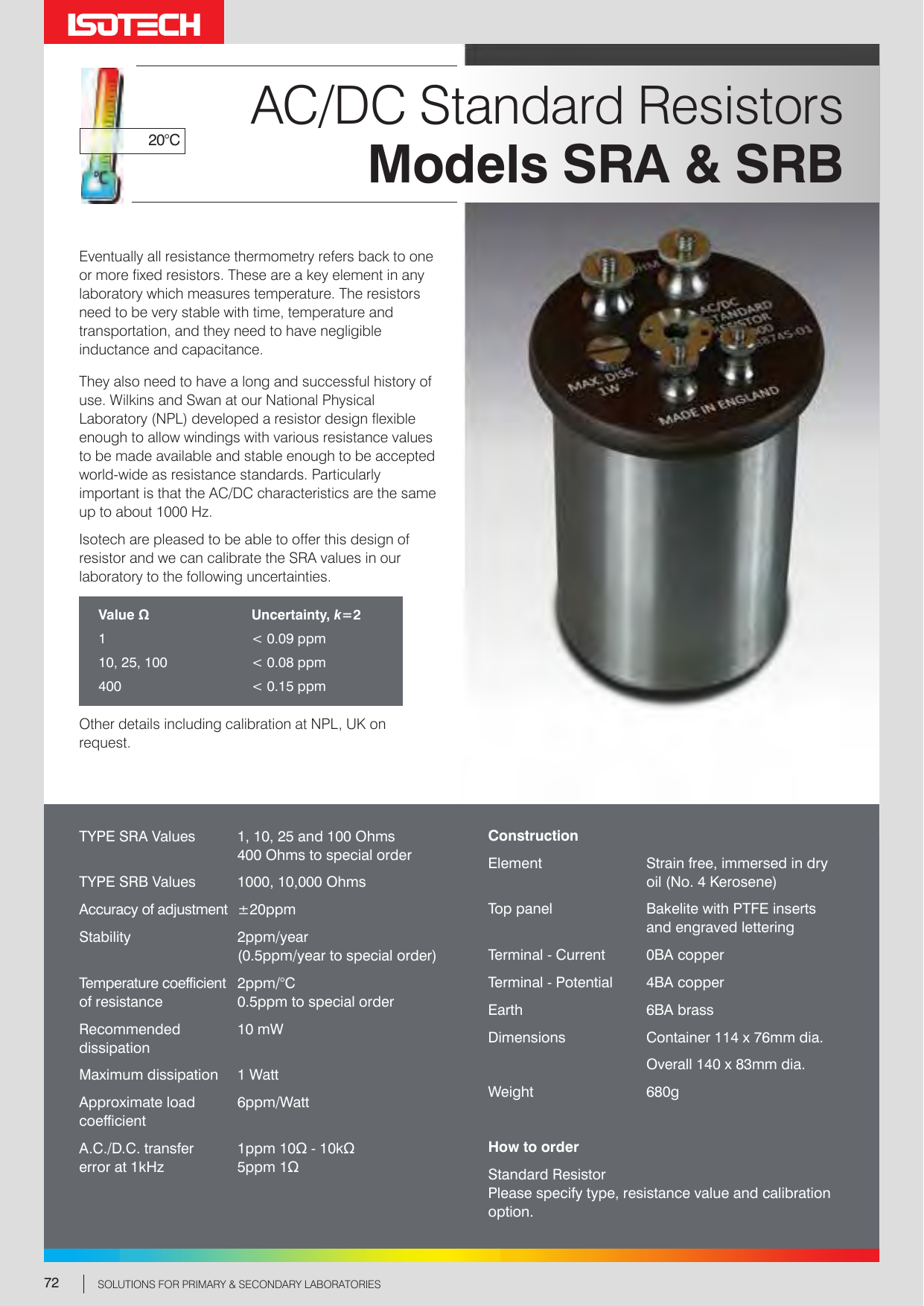
The Isotech AC/DC Standard Resistor (Types SRA and SRB) is a four-terminal, oil-filled resistance standard for precision resistance thermometry, holding the same characteristics on both AC and DC up to about 1000 Hz. Available from 1 Ω to 10,000 Ω, it gives primary and secondary laboratories a stable reference that AC and DC resistance-ratio bridges compare against when calibrating standard platinum resistance thermometers (SPRTs) and other precision sensors. The design traces back to Wilkins and Swan at the UK’s National Physical Laboratory (NPL), and has been built to that proven pattern by H. Tinsley & Co. since 1970.
Who Uses the SRA and SRB Standard Resistors?
Eventually all resistance thermometry refers back to one or more fixed resistors, so a certified standard resistor is a key element in any laboratory that measures temperature. These resistors are built for national metrology institutes, primary and secondary calibration labs, and thermometry labs that calibrate SPRTs, PRTs, and resistance bridges. If your measurements depend on a resistance reference that stays stable with time, temperature, and transportation, and that carries negligible inductance and capacitance, the SRA and SRB are designed for you.
One Standard for Both AC and DC Bridges
The Wilkins design was engineered so the AC and DC characteristics are the same up to about 1000 Hz, which means a single resistor serves both AC and DC resistance-ratio bridges without a separate transfer standard. The AC/DC transfer error is just 1 ppm from 10 Ω to 10 kΩ, and 5 ppm at 1 Ω. The strain-free element is wound to carry negligible inductance and capacitance, so the value you certify on DC is the value you measure on AC.
Stability You Can Certify
Long-term stability is 2 ppm per year, with a 0.5 ppm per year option available to special order. The temperature coefficient of resistance is 2 ppm/°C, again with a 0.5 ppm/°C option to special order. Accuracy of adjustment is ±20 ppm to the nominal value, and every value shares the same rugged, repeatable construction, so a resistor bought today matches one bought years ago.
Calibration and Traceability
Isotech calibrates the SRA values in its own laboratory to low uncertainties (k = 2): better than 0.09 ppm at 1 Ω, better than 0.08 ppm at 10, 25, and 100 Ω, and better than 0.15 ppm at 400 Ω. Calibration at NPL in the UK is available on request, and Isotech North America can supply NIST-traceable calibration for US laboratories. Each resistor is delivered with its calibration certificate, so it is audit-ready for ISO/IEC 17025 quality systems from day one.
Resistance Values and How to Order
Type SRA covers 1, 10, 25, and 100 Ω, with 400 Ω available to special order. Type SRB covers 1000 and 10,000 Ω. Together they span the full 1 Ω to 10,000 Ω range used in resistance thermometry, from low-value SPRT work to high-value thermistor and PRT bridges. To order, simply specify the type, the resistance value, and the calibration option (Isotech laboratory or NPL).
Precision Construction
The resistance element is wound strain-free and immersed in dry oil (No. 4 Kerosene) to damp out the time and temperature instabilities that affect air-wound resistors. The top panel is Bakelite with PTFE inserts and engraved lettering; current terminals are 0BA copper, potential terminals are 4BA copper, and the earth terminal is 6BA brass. Recommended dissipation is 10 mW, maximum dissipation is 1 W, and the approximate load coefficient is 6 ppm/W. Each resistor weighs 680 g in a container measuring 114 x 76 mm in diameter (140 x 83 mm overall).
A Complete Resistance Thermometry System
Pair the SRA and SRB standard resistors with an Isotech microK² thermometry bridge for the ratio measurement and/or a Standard Resistor Maintenance Bath (Model 455) to hold the resistors at a controlled temperature. Together they form an end-to-end resistance thermometry workflow backed by Isotech’s decades of temperature metrology expertise.
Frequently Asked Questions
What is an AC/DC standard resistor used for?
It provides a stable, precisely known reference resistance that a thermometry or resistance-ratio bridge compares against when measuring an SPRT, PRT, or thermistor. Because resistance thermometry ultimately refers back to fixed resistors, the standard resistor anchors the traceability of the whole temperature measurement.
What is the difference between Type SRA and Type SRB?
Type SRA covers the lower values of 1, 10, 25, and 100 Ω (400 Ω to special order) and can be calibrated in the Isotech laboratory to uncertainties below 0.15 ppm. Type SRB covers the higher values of 1000 and 10,000 Ω. Both share the same oil-filled, strain-free construction.
Why does matched AC and DC performance matter?
Because the AC and DC characteristics are the same up to about 1000 Hz, one resistor can be used with both AC and DC bridges, and the value certified on DC transfers to AC with an error of only 1 ppm from 10 Ω to 10 kΩ. That removes the need for separate AC and DC transfer standards.
How stable are the SRA and SRB resistors?
Standard stability is 2 ppm per year and the temperature coefficient is 2 ppm/°C, with 0.5 ppm options available to special order. The strain-free element in dry oil keeps the value repeatable through handling and transport.
How are the resistors calibrated?
Isotech calibrates the SRA values in-house to uncertainties (k = 2) of better than 0.08 ppm to 0.15 ppm, depending on the value, with NPL calibration available on request.
| Model |
Type SRA |
Type SRB |
| Resistance Values |
1, 10, 25, 100 Ω (400 Ω to special order) |
1000, 10,000 Ω |
| Calibration Uncertainty [1] |
1 Ω: <0.09 ppm; 10, 25, 100 Ω: <0.08 ppm; 400 Ω: <0.15 ppm (k = 2) |
NPL calibration on request |
| Reference Temperature |
20°C |
| Accuracy of Adjustment |
±20 ppm |
| Stability |
2 ppm/year (0.5 ppm/year to special order) |
| Temperature Coefficient of Resistance |
2 ppm/°C (0.5 ppm/°C to special order) |
| AC/DC Transfer Error at 1 kHz |
1 ppm (10 Ω to 10 kΩ); 5 ppm (1 Ω) |
| Recommended Dissipation |
10 mW |
| Maximum Dissipation |
1 W |
| Approximate Load Coefficient |
6 ppm/W |
| Element |
Strain-free, immersed in dry oil (No. 4 Kerosene) |
| Top Panel |
Bakelite with PTFE inserts and engraved lettering |
| Terminal, Current |
0BA copper |
| Terminal, Potential |
4BA copper |
| Earth |
6BA brass |
| Dimensions |
Container 114 x 76 mm dia.; overall 140 x 83 mm dia. |
| Weight |
680 g |
| How to Order |
Specify type, resistance value, and calibration option (Isotech laboratory or NPL) |
[1] SRA values calibrated in the Isotech laboratory; uncertainties quoted at k = 2 and depend on resistance value.
|
|
|
 |
|
 |
|
|
|
 |
|
 |
|
Literature
|
|
|
|
| AC/DC Standard Resistor SRA & SRB Datasheet |
|
|
|
|
|
|
|
|
|
|